
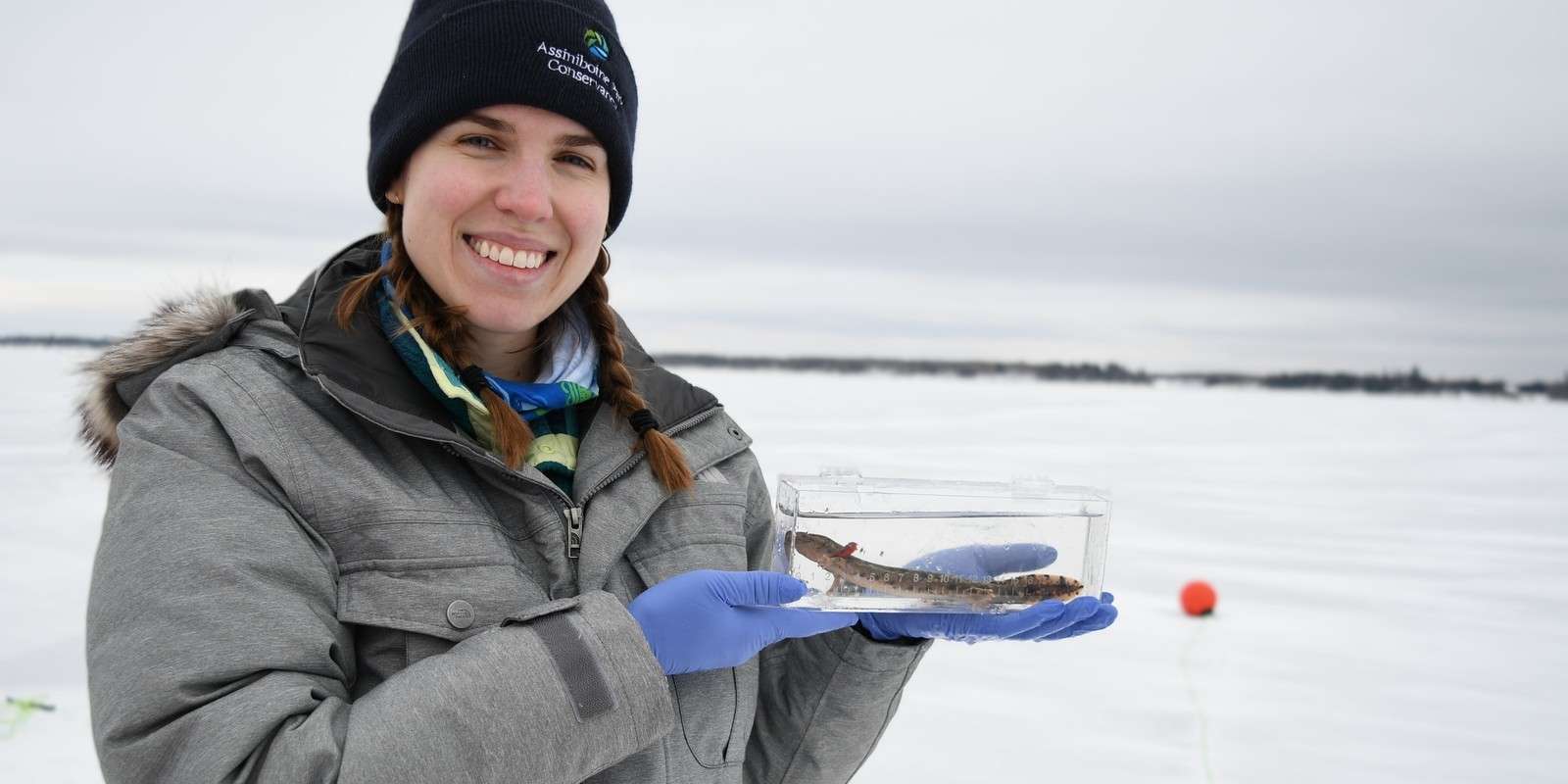
The Conservation and Research team is just beginning this year’s Manitoba mudpuppy eDNA sampling. The Manitoba mudpuppy (i.e., Manitoban populations of the Common mudpuppy) is a fully aquatic salamander, just like its better-known relative, the axolotl. Unfortunately, the Manitoba mudpuppy is considered Threatened.
Building on previous work, the eDNA project is expanding to include additional testing sites. By sampling across a wider area and including more tributaries, the team hopes to build a more detailed picture of the mudpuppy’s range in Manitoba to establish a baseline distribution.
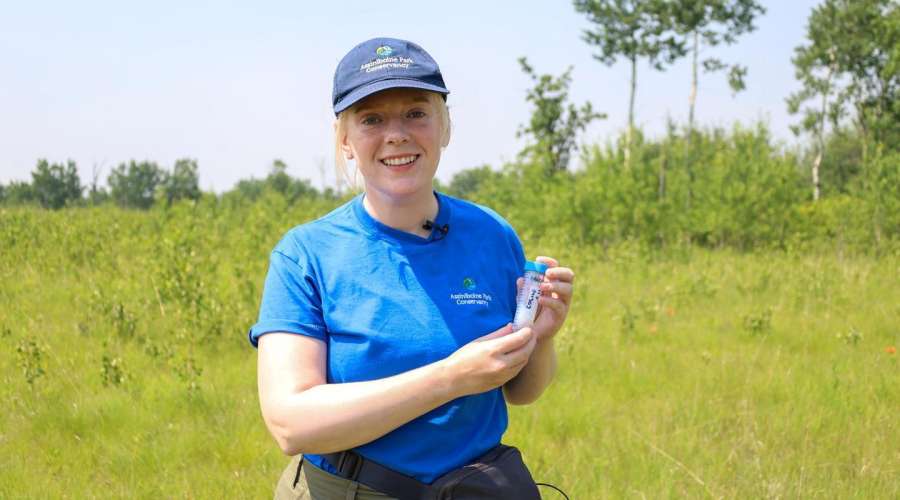
In this researcher spotlight, Brooklynne Keber, Conservation Research Specialist in Assiniboine Park Conservancy’s Conservation and Research Department, shares more about the project, the role environmental DNA plays in understanding where Manitoba Mudpuppies live, and what continues to inspire her conservation work.
Q: What is the project?
A: This research uses a non-invasive method to detect the presence of the DNA of the target species in an environmental sample, called environmental DNA (eDNA). Specifically for Manitoba Mudpuppy, this involves collecting and filtering water samples from waterbodies across Manitoba. In the lab, we extract the eDNA collected on the filter and use specialized techniques to determine if eDNA of Manitoba Mudpuppy is present or absent in that sample.
Q: Tell us a bit more about yourself and how you got involved with this project.
A: My name is Brooklynne Keber, and I am a Conservation Research Specialist in the Conservation and Research Department of Assiniboine Park Conservancy. My specialties are using genomic and genetic tools to answer conservation questions. I first started doing this type of work during my undergraduate degree at the University of Manitoba and enjoyed it so much that I decided to make it the focus of my master's thesis. Upon completing my master's degree, I graciously joined the Conservation and Research team at APC.
Q: Why are you passionate about working in conservation?
A: I have always been fascinated by living things. Over my life, I have seen the areas I explored as a child change and have seen biodiversity loss and species extirpation firsthand. I loved growing up in nature and exploring Manitoba, and I want my children and their children to be able to have similar opportunities and experiences as I did as a child. Understanding the distribution of species at risk is an essential step in protecting critical habitat for these species, and biodiversity in general.
Q: Why does this project matter for the future?
A: This project allows us to establish a baseline distribution of the Manitoba Mudpuppy. When the historic distribution or abundance of a species is unknown, it can fall victim to the shifting baseline syndrome, where each human generation inherits a progressively degraded environment, but accepts it as the ‘normal’ state because we do not have any data to suggest otherwise. As historical knowledge is lost, we are unable to recognize the true scale of long-term environmental decline. Before this project began, much of what we knew about the historic distribution of Manitoba Mudpuppy was based on angler by-catch. With this project, we have been able to and continue to expand our understanding of the current and historic distribution of Manitoba Mudpuppy.
Q: Can you share an interesting story or a sweet memory that happened while you were out in the field?
A: There is a spot along the Brokenhead River that I have collected eDNA samples from for many species at risk and for various projects, which is by the farm my Dad grew up on. When my Dad was young, he used to play in that exact spot where I have collected samples along the river with his siblings. I also did the same with my siblings when I was young, and we were at the farm visiting my Grandma. It has felt like such a ‘full circle’ moment to be able to continue to visit that spot, now for research, and to learn from my Dad about the species at risk that can be found at that spot given what he remembers seeing as a child. I have even taken him with me a couple of times to collect samples there!
Q: What advice would you give to future researchers/younger version of yourself about the work you’re doing/field you’re in?
A: My advice for future researchers is to be flexible and open to new opportunities, and that finding a mentor and/or team you enjoy working with is more important than the project itself. The world of science is always changing, and it is essential to be able to adapt to the change. Having the support of a great mentor and/or team makes it easier to adapt to these changes and makes learning new things much more enjoyable!