
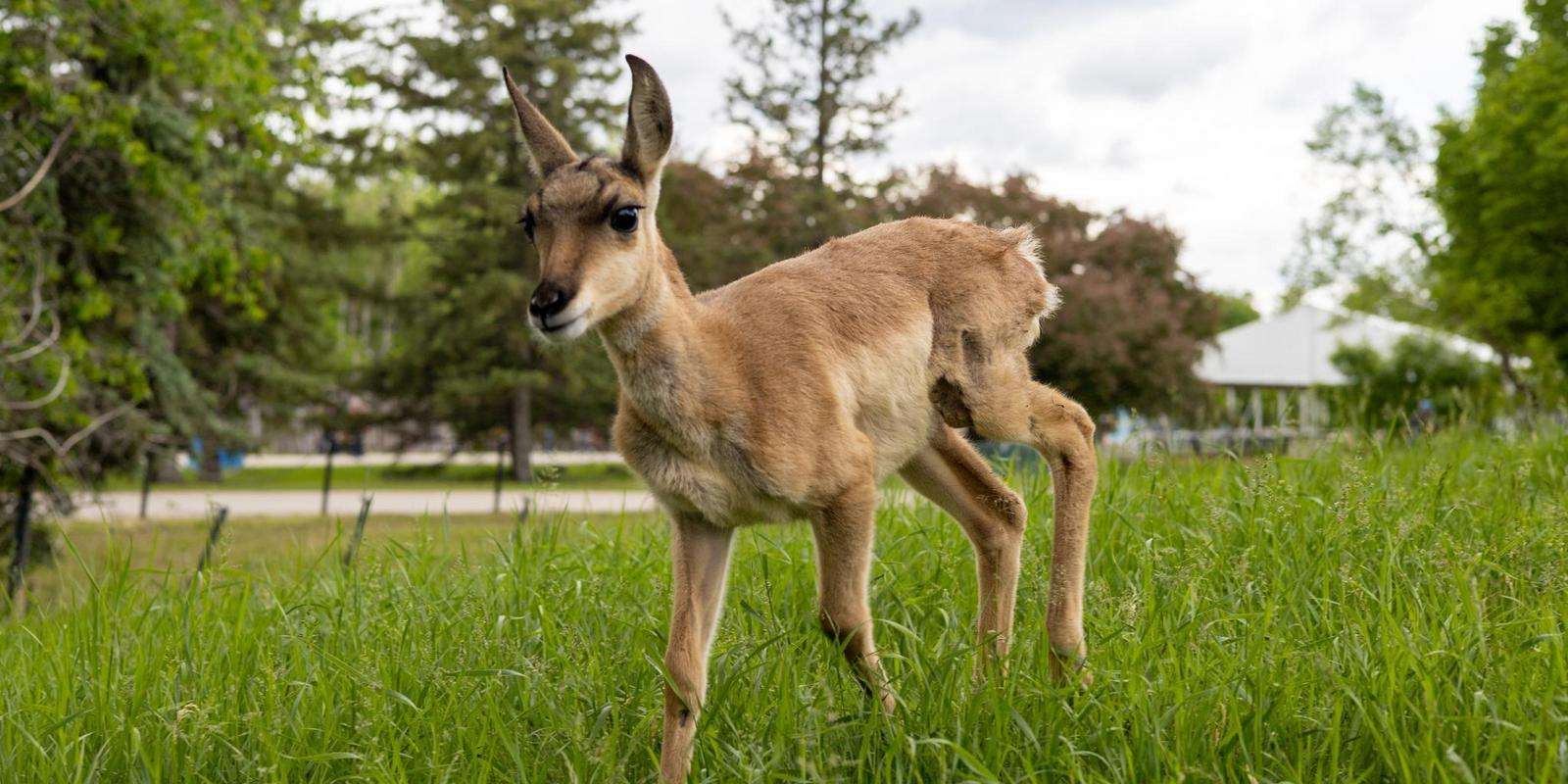
Meet the newest member of our pronghorn herd!
This little one’s story started under unfortunate circumstances. At approximately one week old she was found entangled in a fence by a member of the public in Alberta. She had a large skin wound on the inside of her hind legs, and her mother was nowhere to be seen. Unfortunately, her injury and the absence of her mother made her non-releasable. She was, however, feisty and mobile.
Since then, she has been on quite a journey. Here at the Zoo, we were contacted by the Senior Wildlife Biologist from Alberta Environment and Protected Areas to confirm our ability to take her in. She was then transported to a wildlife rehabilitation facility, Alberta Institute for Wildlife Conservation (AIWC), where the veterinary team stabilized her and began supportive feeding. Within 48 hours, she was transferred to the Wilder Institute/Calgary Zoo for surgery and longer-term care. She healed very well from her surgery and grew stronger each day while at the Wilder Institute/Calgary Zoo’s Animal Health Centre.
Once stable, she travelled to Winnipeg with our vet team to be integrated into our pronghorn herd.
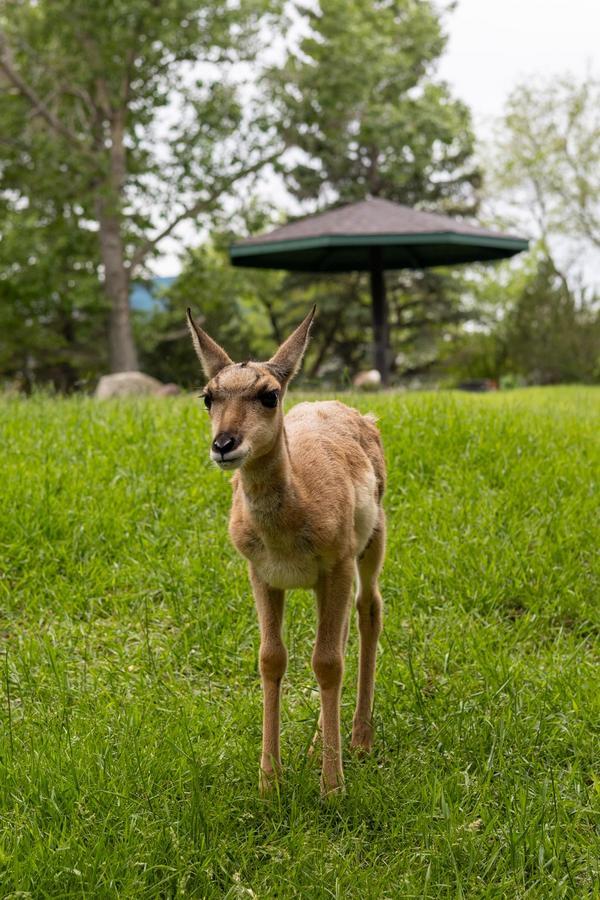
The new baby pronghorn is very curious and sweet!
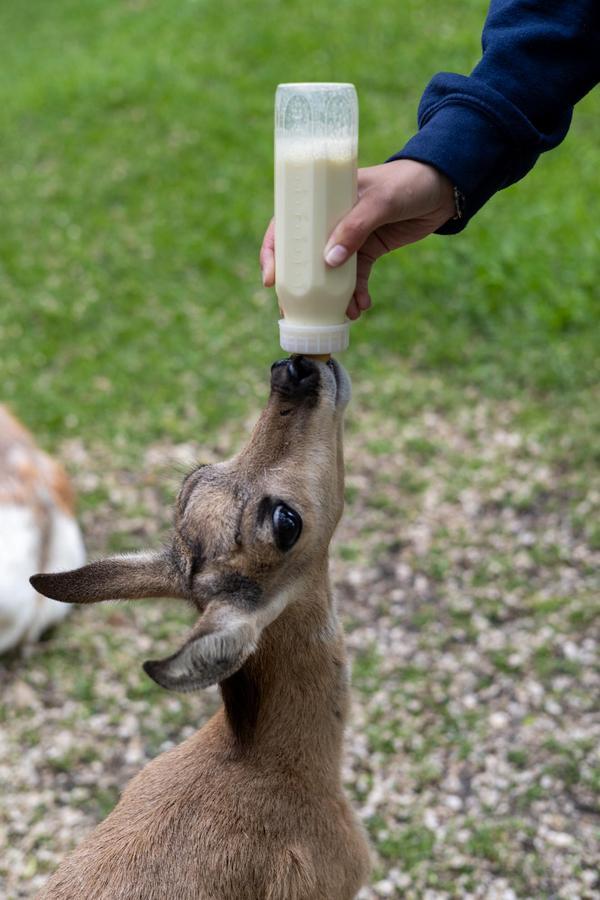
She is currently being bottle fed but with the help of her animal care team, is being weaned off of bottles gradually.
After being assessed by our veterinary team at Assiniboine Park Zoo’s Animal Health Centre, gradual introductions began with our resident adult female pronghorn, Tilly and Fernie. Introductions are slow and thoughtfully planned to prioritize the safety and comfort of every animal.
First, she was able to see and listen to her new habitat from behind the scenes, then she started exploring. Once she seemed comfortable, Tilly joined her, then Fernie.
Now at around 6 weeks of age, she is settling in well on the pronghorn field with plenty of supervision from her care team. While she is still bottle-fed, she has started the transition to solid food.
Pronghorns are native to North America and can be found in Saskatchewan and Alberta. They are very well adapted to life in the grasslands with protruding eyes on the sides of their heads, giving them a wide field of vision to spot predators. They are the fastest land animal in North America!
She is adorable, curious, and we can't wait for you to meet her!
Thank you to the Wilder Institute/Calgary Zoo and the AIWC for providing this little lady with such great care!