What is Environmental DNA?
Every animal leaves traces of itself behind. Skin cells, mucus, waste, blood and other biological material are constantly shed into the environment. These tiny genetic traces, known as environmental DNA (eDNA), can be collected from water, soil or even air and used to detect species without ever seeing or capturing them.
For conservation scientists, eDNA has become a powerful tool. It lets us search for rare or hard-to-find species by looking for their genetic fingerprints in the environment. This is especially useful for species that occur in low numbers or occupy large geographic areas, such as Manitoba’s elusive mudpuppy.
Meet the Mudpuppy
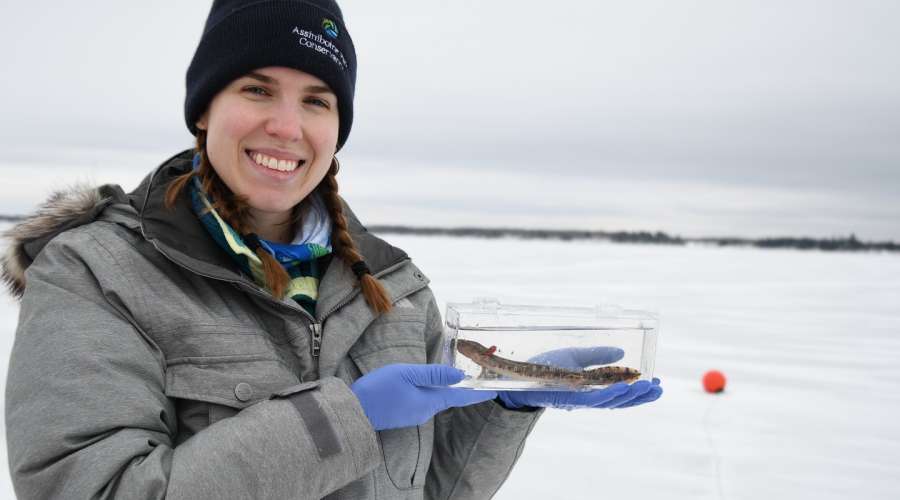
The Manitoba Mudpuppy, a population of the Common Mudpuppy (Necturus maculosus), is a fully aquatic salamander and a species currently considered threatened.
.jpg)
Since 2024, the Assiniboine Park Conservancy Conservation and Research team has been working to better understand where mudpuppies occur across Manitoba. Historical reports, community observations, fishing reports, and submissions to our Manitoba Mudpuppy iNaturalist project help guide where we search next. Each year, we focus on new regions to fill gaps in our knowledge and build a clearer picture of the species’ distribution.
.png)
Distribution of the Manitoba Mudpuppy using iNaturalist data collected from citizen scientists. This data is one small element that helps the Conservation and Research team decide where to sample mudpuppy eDNA to better understand the species' distribution. Map was created in RStudio by Morgan Anderson using data from the Manitoba Mudpuppy iNaturalist project.
How Do We Find Mudpuppies Using eDNA?
Rather than searching directly for mudpuppies, we search for the DNA they leave behind.
.png)
Typical workflow for the collection and amplification of eDNA. How the samples are collected and filtered can vary from project to project, but the overall goal of maintaining clean practices to minimize contamination remains consistent. For the mudpuppy samples, qPCR is used to detect the presence or absence of their DNA in the sample. This infographic was developed by GEN-FISH.
The First Step is Sampling
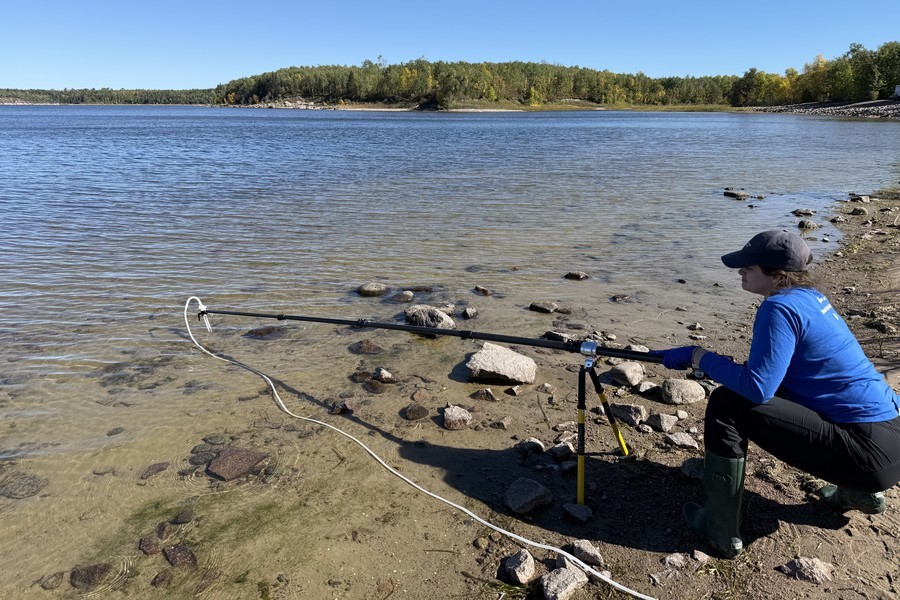
At each site, water is filtered using a specialized Smith-Root eDNA sampling system. Before sampling begins, we run a sterile-water control to ensure that no DNA from previous sites has contaminated our equipment. Because eDNA methods are highly sensitive, preventing contamination is critical.
To increase confidence in our results, we collect three replicate samples at each location and typically filter about four litres of water per site.
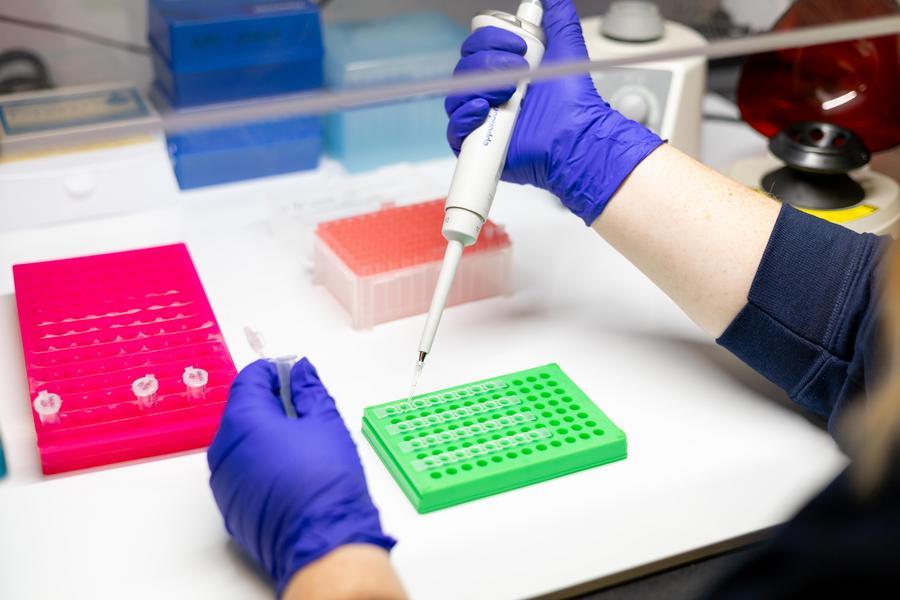
Back in the lab, samples are kept cold to preserve DNA before undergoing a two-day extraction process. This removes unwanted material and leaves behind any DNA present in the water sample.
Detecting Mudpuppy DNA with Quantitative Polymerase Chain Reaction (qPCR)
The final step uses a technique called quantitative Polymerase Chain Reaction (qPCR) that determines the presence or absence of the target species’ DNA from the sample. Think of it like finding a missing puzzle piece. A mudpuppy-specific assay acts like a molecular detector, searching the sample for a piece of DNA that matches the mudpuppy. If that DNA is found or amplified, a positive detection is given.
A non-detection does not always mean mudpuppies are absent. Water flow, temperature, seasonality, and other environmental factors can influence how much DNA is present and how easily it can be detected. Combining eDNA results with knowledge of mudpuppy ecology helps us interpret what the data are telling us.

Why eDNA Matters
eDNA is a powerful conservation tool, but it is not a replacement for traditional fieldwork. Techniques such as netting and angling still provide important information about an aquatic animal’s health, size, age and sex.
When used together, traditional surveys and eDNA give researchers a much more complete understanding of species distributions and population status, helping guide future conservation efforts.
How You Can Help
Want to help support mudpuppy conservation?
- Help keep Manitoba's rivers, lakes, and streams healthy by reducing pollution and preventing the spread of invasive aquatic species.
- If you accidentally catch a mudpuppy while fishing, carefully release it back into the water and avoid touching its delicate external gills.
- Report mudpuppy sightings by sharing a photo and location with the Conservation and Research team or by uploading your observation to the Manitoba Mudpuppy iNaturalist project.
Every observation helps us learn more about these fascinating salamanders and supports their conservation across Manitoba.
You can also support conservation research by visiting the Zoo or Park, or by donating to the Wildlife Conservation Fund.